In my childhood home in Jakarta, we had wall paintings of potted flowers—a matching set of four different kinds. They each grew in different seasons, and none of them were native to Indonesia, but I remember marveling at the painted blossoms as a child, before my mother got rid of them years later. My favourite of the bunch is the snowdrop, which, according to the painting, flowered from January to March.
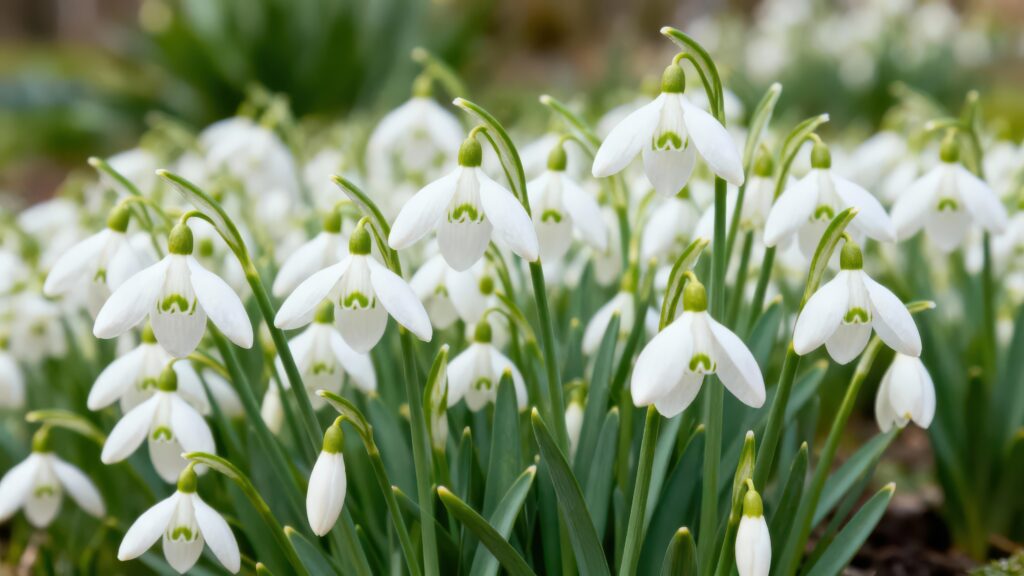
Captivating Snowdrop Flowers Showcasing Spring’s Beauty – Erwin Pieloor
Some fifteen years later, I moved away from home to study in Germany. The excitement of being in a new country and deciding my own day-to-day routine after living with my parents for almost 20 years of my life wore off when the full force of a COVID-19 winter hit me. I, along with the rest of the northern hemisphere, got only about 8 hours of natural light daily and had to cope with freezing temperatures. And I, along with the rest of the world, stayed within the same four walls most of the time. Combined with the start of my first exam season (Prüfungszeit) constantly looming over my shoulder like a stifling fog, it was a recipe for plain suffering.
But one day after running errands at subzero temperatures, to my absolute delight, I saw it for the very first time: a patch of snowdrops, just like in the painting from my childhood, quietly blooming on the frozen ground at a traffic junction. The stoplight quickly turned green, so along with everyone else I resumed walking, but not without a spark of hope for better days in my heart.
And in the end, it did get better. Quarantine regulations loosened ever so slightly. My boyfriend came to visit. I passed all my exams well, made new friends, moved out of my extremely quiet suburban flat into one closer to campus, and eventually got a part-time job to help finance my studies. I noticed the birds started to sing in the wee hours of the morning, and in the park across my flat crocuses burst from the ground between newly sprout grass—I could even see the purple specks between the green all the way from my window on the third floor. During the day it became warm enough to leave the window open longer, so I could hear it all: birds, the rush of the river right next door, the rustle of the wind through the trees and bushes, and people, by God, the people. And it always invited me to take a walk outside, which did wonders for my wellbeing.
“So they say it’s spring?”
So my love for spring might be a little biased, but throughout my life in this corner of Germany, spring is without a single doubt my favourite season. This is why it irks me that at the first dramatic drop in temperature followed by the first sunny days in March or April, people start to complain, as people always do. Just a couple months ago at the beginning of April, we had a week where the weather oscillated between sunshine, rain, snow, gale-force winds, and slush. And just like clockwork, my Instagram stories were flooded with pictures documenting this, accompanied by “So they say it’s spring?” comments and eye roll emojis.
I consider myself a scientist, so I like data—one German survey showed that with 44% responders choosing it, summer reigned as favourite season. Spring came in second with 34%. One thing that I am curious about: what percentage of people I saw complaining about spring weather on social media would choose summer as their favourite season? My hypothesis is that people expect spring to be summer when it clearly isn’t and complain when spring does spring things.
In a way, this is a bit like the cat vs. dog argument all over again. Spring, much like cats, is its own season. It’s unpredictable. It always finds itself in the shadow of the golden child, summer (analogous to dogs). But perhaps in our yearning for warmth after the bone and chill of winter, we want so much for spring to be all sunshine and flowers, so upsets us when those expectations aren’t met.
“April does what april wants to do.”
Okay, maybe that’s overly anthropomorphizing meteorological phenomena and I shouldn’t do that—there is an actual physical reason for that unpredictability. The Germans like to say, “April does what April wants to do,” but in temperate regions, spring is simply a transitional season between the coldest (winter) and the warmest (summer) it can get. Despite the sun getting stronger and the days longer, cold air from the north meets warmer air from the south and moist Atlantic air from the west. This atmospheric instability causes dramatic rises and drops in temperature and increases the chance of storms and hail.
I, however, love spring for what it is—at its best and at its worst. I do not love it simply because it just happens to be the transition before summer; I love it most because it is a symbol of hope and resilience. It is a promise. At times spring feels like winter, but I know that each inevitable cold spell will be followed by an inevitable warming, even if it takes time for the warmth to be more permanent.
Spring arrives unceremoniously heralded by a million signs if you care to look, and every year my heart sings with them. Yes, there is frost outside, but the birds start to sing, nonetheless. Yes, the ground is freezing, but the snowdrops quietly bloom and the ramsons are growing. Yes, the evenings are chilly, but the sun might come out tomorrow. Yes, life is hard, but we will prevail and the fruits will be beautiful.
Now that you know what spring is like in Germany, click here to read what Adeline’s experience is like in Indonesia.