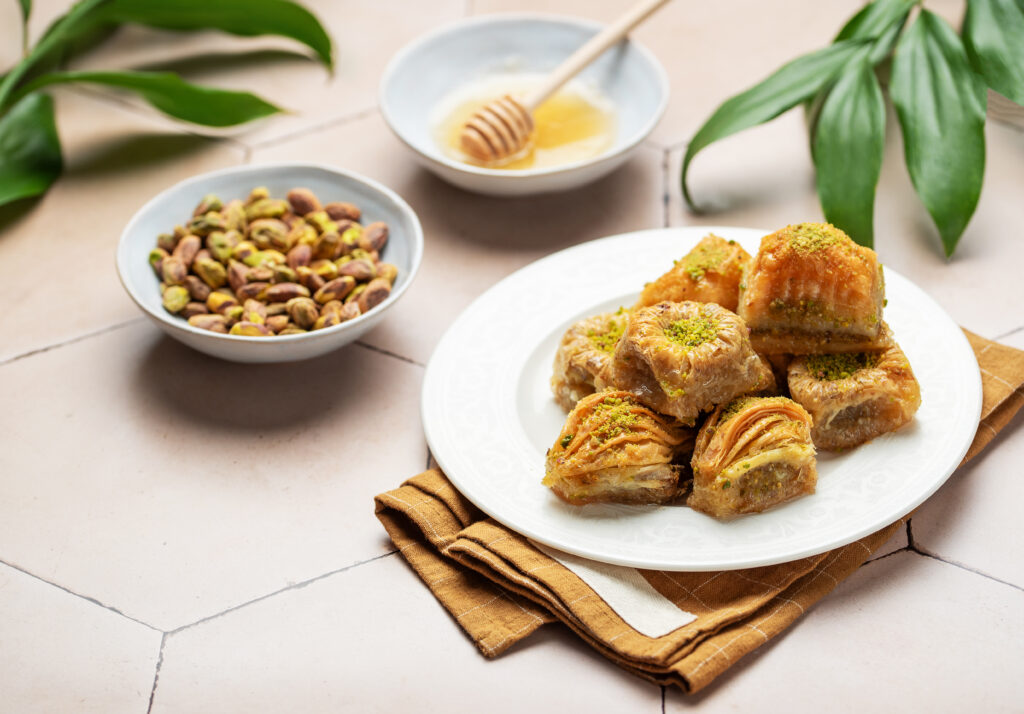
During college, post-lock down in New York City, I was obsessed with eating and making baklava. I would go on long walks around the city just to reward myself with baklava, then take the train back home. I would try different kinds of baklava — Greek baklava from Poseidon Bakery (which was really rich in walnuts), Hungarian baklava (a mixture of pistachio and walnut), and Turkish baklava from New Jersey’s Güllüoğlu Baklava & Cafe (full pistachio). I ended up loving the pistachio one the most. I would scour Jackson Heights, Queens, where there were a lot of Bangladeshi and Indian markets, to grab the spices and ingredients. For my first attempt, I bought ready-made phyllo dough. But sometimes I was too lazy to pick it up, and it would often be sold out at most of the supermarkets near me, so I ended up making my own phyllo dough.
Greek, Hungarian, or… turkish?
Perhaps the most disputed thing about baklava isn’t which nut makes the best filling (the general consensus seems to be pistachio), but its origin. Many cultures have raised hands, staking claims that their version is the true, original, and therefore best baklava out there. But, much like the many dishes out there, baklava is not immune to acculturation. The dish has become such an important part of many culinary identities, that you could pull a line from Greece to Oman on the world map, and a good chunk of the people from all those countries will have their own national version of the baklava. Its roots, however, dates back to ancient times – when great empires stood and fell. People of the Assyrian empire would make an consume layers of thin dough stuffed with nuts in between – the earliest version of a baklava – and the practice all the way to Greece, where they made a nut-free version (they used cheese and honey instead of nuts) instead. But, the baklava that we are most familiar with today has Ottoman roots, where it was first referenced by a 15th Century Turkish poet.
Many dishes are birthed from the mix of two distinct cultures, but few are as well traveled as the baklava. Transcending religions, and crossing trade routes, the baklava is a delicious evidence of the strength of human connection. In my own search for the best baklava, I explored many parts of the city, and met with many wonderful people. Bought ingredients which originate from more countries I can count, from stores whose owners come from cultures all over. I then spent months making my own version of this dessert, with my own little twist. We may never reach a consensus on which country or culture the baklava truly belongs to, but we can all agree that it is absolutely delicious.
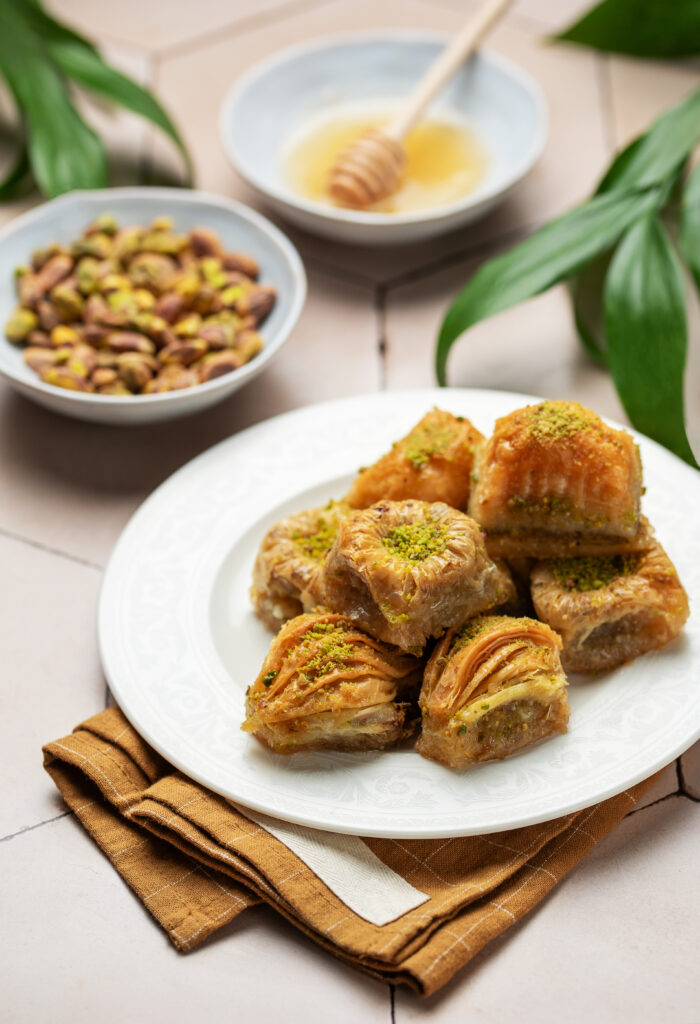
Here are the recipes for my homemade phyllo dough and pistachio baklava. This recipe is almost as long as baklava’s history, but I promise it’ll pay off. And if I may give my two cents – it tastes much better when syrup is switched out with honey.
Pistachio-honey baklava recipe
Yield: 10 Servings
Prep Time: 1 hour
Cook Time: 7 hours
Total Time: 7-10 hours
Equipment Needed:
Homemade Phyllo Dough
- Large mixing bowl
- Measuring cups and spoons or a kitchen scale
- Rolling pin
- Small bowl or plate for cornstarch
- Clean kitchen towel or plastic wrap
- Pastry brush, optional
- Large clean working surface
- Knife or dough scraper
Baklava
- 9×13-inch (23×33 cm) baking pan
- Large knife
- Cutting board
- Pastry brush
- Mixing bowl
- Measuring cups and spoons or a kitchen scale
- Small saucepan
- Wooden spoon or heatproof spatula
- Clean kitchen towel
- Chopping knife or food processor for the pistachios
Ingredients:
Homemade Phyllo Dough
- 500 grams all-purpose flour
- 150–200 grams cornstarch (for separating layers)
- 300 ml warm water, approximately
- ½ cup (115 grams) melted ghee or refined coconut oil
- 2 tbsp vegetable oil
- 1 tsp fine sea salt
- 1 tsp vinegar or lemon juice
Pistachio Filling
- 3 cups (about 340 grams) shelled pistachios, roughly chopped
- 1 tsp ground cinnamon
- ½ tsp fine sea salt
- ¼ tsp ground cardamom, optional
Honey-Rosewater Syrup
- 1¼ cups (about 425 grams) honey
- ½ cup (120 ml) water
- 1 tbsp rosewater
- 1 tsp fresh lemon juice
- ¼ tsp fine sea salt
- 1 strip lemon peel, optional
Directions:
Making Homemade Phyllo Dough
- Mix flour and salt in a large bowl. Add the warm water, oil, and vinegar or lemon juice. Mix until a dough forms.
- Knead for about 8–10 minutes, until the dough is smooth and elastic.
- Cover the dough and let it rest for 30–60 minutes.
- Divide the dough into 10–12 equal balls. Keep them covered so they don’t dry out.
- With a rolling pin, flatten each ball into a small disc.
- Generously dust each disc with cornstarch, then stack the discs on top of one another, adding cornstarch between every layer.
- Roll the entire stack together into a large, thin sheet. The cornstarch will prevent the layers from sticking together.
- Carefully peel the individual sheets apart, brushing away any excess cornstarch.
- Keep the phyllo sheets covered with a slightly damp kitchen towel while you work so they don’t dry out.
Making Honey-Rosewater Syrup
- Combine the honey, water, lemon juice, lemon peel, and salt in a small saucepan.
- Bring to a gentle simmer over medium-low heat, and cook for 5 minutes. Stir occasionally.
- Remove from the heat, remove the lemon peel, and stir in the rosewater.
- Let the syrup cool completely.
Chopping Pistachio Filling
- Roughly chop pistachios.
- In a bowl, mix the chopped pistachios, cinnamon, cardamom, and salt.
- Leave a handful aside for garnish.
Assembling The baklava
- Pre-heat oven to 350°F (175°C).
- Brush a 9×13-inch (23×33 cm) baking pan with some melted ghee or coconut oil.
- Place one sheet of homemade phyllo in the pan and brush lightly with melted ghee or oil. Repeat until you have 8 sheets layered on the bottom.
- Sprinkle over ⅓ of the pistachio filling.
- Add 4 more sheets of phyllo, brushing each with ghee or oil, then add another ⅓ of the pistachio filling.
- Finish with the remaining phyllo sheets, brushing each layer with ghee or oil. Give the top sheet a generous final brushing.
- Cut the assembled baklava into diamonds or squares with a sharp knife, cutting all the way through.
- Bake for 40–50 minutes, until deeply golden brown and crisp.
- Immediately after removing the hot baklava from the oven, slowly pour the cooled honey syrup evenly over the entire surface. It should sizzle as it hits the baklava.
- Let the baklava sit uncovered for at least 4 hours, preferably overnight. The flavors will develop and the syrup will soak into the layers.
- Garnish with salt and remaining chopped pistachio.
Enjoy!
Have fun with it!
Feel free to customize the dessert to your liking using a few tips and tricks listed below.
Saving time and patience
Making homemade phyllo dough is completely optional. If you can easily find ready-to-use phyllo dough, feel free to skip the homemade phyllo recipe and go straight to making the baklava. Just use approximately 1 package (about 450 grams / 16 oz) of ready-made phyllo dough instead. I only started making my own because phyllo dough was often sold out near me, or I was too lazy to go out and buy it. But, if you’re up for the challenge, don’t be afraid to use plenty of cornstarch between the homemade phyllo layers. Its job is to prevent them from sticking. Brush off any excess before layering the baklava.
Sugar, Spice, and everything salty.
The salt is important—it keeps the honey from making the baklava taste one-dimensionally sweet. For a particularly luxurious version, add ½ tsp flaky sea salt over the finished baklava just before serving.
non-dairy alternative
The same way it has transcended cultural barriers, it to shall go through dietary restrictions, for baklava deserves to be enjoyed by folks of all kinds. Use ghee if you want a rich, buttery baklava; use refined coconut oil for a dairy-free version without much coconut flavor.